What the European Rover Challenge actually asks of a rover
A field guide to the competition we build for — the Marsyard, the five mission types, how teams are scored, and what makes it genuinely hard.
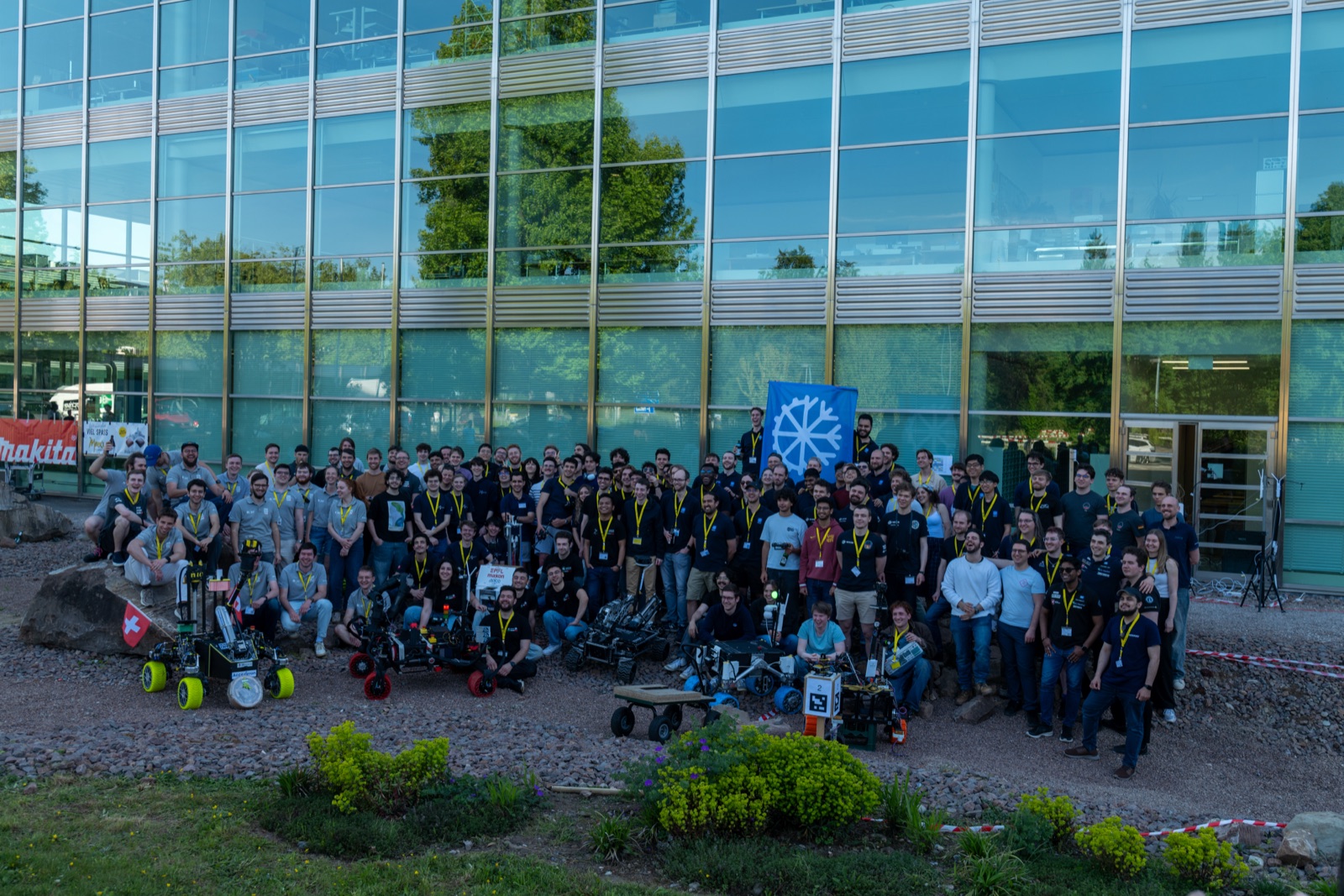
Every design decision on our rover eventually gets justified with the same three words: “for the ERC.” So it is worth spelling out what the European Rover Challenge actually is, and why a competition on an artificial patch of Poland is such a demanding target to build for.
An artificial Mars in Poland
The ERC is an annual international space-robotics competition — billed as the largest robotics and space event in Europe — organised under the European Space Foundation and held in Poland. It ran for years in Chęciny and then Kielce; since 2024 the finals have been hosted at AGH University in Kraków, where FHNW won the 10th edition on 6–8 September 2024.
The centrepiece is the Marsyard: a purpose-built artificial Mars terrain, shaped by planetary geologists to echo real Martian landscape-forming processes — impact craters, dunes, dry river valleys and volcanic formations. For the 10th edition the organisers added a canyon inspired by Valles Marineris, the largest canyon in the Solar System. It is not a tidy obstacle course; it is loose, uneven, sun-baked ground designed to punish anything that assumes flat and firm.
Five things a rover has to do
The on-site competition is built from missions modelled on real NASA and ESA operations. Broadly, a rover has to prove itself across five fronts:
- Navigation. The rover reaches a series of checkpoints across the Marsyard — five, in the “traverse” — and there is a separate droning subtask flying to instructions and capturing photos. Crucially, doing the traverse autonomously, with no video feedback, is scored far more generously than teleoperating it.
- Science. Not just fetching dirt: teams work a scientific hypothesis end to end — literature review, an exploration plan, then collecting and analysing surface samples with on-board instruments, and delivering a report. This is where geologists and, for us, life-scientists earn their place on the team.
- Probing. The subsurface sibling of the science task: drill down, extract material from below the surface, and analyse what comes up. Drilling into unknown ground without toppling the rover or snapping a bit is its own engineering problem.
- Maintenance. Fine remote manipulation against a panel of hardware — configuring switches, measuring electrical parameters, powering on an electromagnetic lock, and seating an RJ-45 plug into a socket. Doing it autonomously, again, scores better.
- Presentation. Judged separately from the field, teams explain how they worked, what they built and why, and how they solved the problems they hit. The rover is only half the score; the engineering process is the other half.
The constraints are the point
What makes the ERC hard is not any single task — it is the conditions all of them run under.
You cannot see your rover. Operators sit in a control station without line of sight to the machine. Everything you know about where the rover is and what it is touching comes back through its own cameras and sensors, over a link that can drop. Every subsystem we build has to assume the human is half-blind.
GPS is not allowed. There is no satellite fix to lean on. The rover has to localise itself from vision, LiDAR, an IMU, wheel odometry and fixed markers — which is exactly why our localisation stack fuses all of them instead of trusting any one.
Autonomy is rewarded, not required. You can teleoperate almost everything and still score. But the competition deliberately tilts the points toward machines that navigate, and even manipulate, on their own — so the ambitious path and the high-scoring path are the same path, and it is the harder one.
Time and terrain are unforgiving. Missions run against the clock on loose, sloped ground, and a rover that gets stuck, overheats or loses its link simply stops earning points. Reliability is a feature that competes directly with ambition for engineering hours.
How it adds up
Scoring is straightforward in shape and brutal in practice: each task awards points for how well you perform it, and the overall winner is the team with the highest total. In 2024 the ceiling was 3,000 points. FHNW took first place across a field of 24 on-site teams with 2,258.24 of them — ahead of AGH Space Systems and ITU Rover Team. That is a little over 75% of a perfect run, which gives a sense of how few teams get close to clearing everything the Marsyard puts in front of them.
That number is also why the rest of these field notes exist. Autonomous navigation with no video feed, a manipulator precise enough to seat a network plug from a distance, science instruments that survive being bolted to a bouncing chassis — none of it is gold-plating. It is all, quite literally, for the ERC.